When people talk about “World Cup teams you can trust,” Germany is almost always the first name mentioned. Not because of hype, but because the numbers keep backing it up: trophies, finals, deep runs, and a long list of players who rose to their best when the pressure was highest.
This is your upbeat, stats-first introduction to Germany’s World Cup identity: what they’ve achieved, what makes them so consistently dangerous, and a few fun facts that capture why Germany is often viewed as the ultimate tournament team.
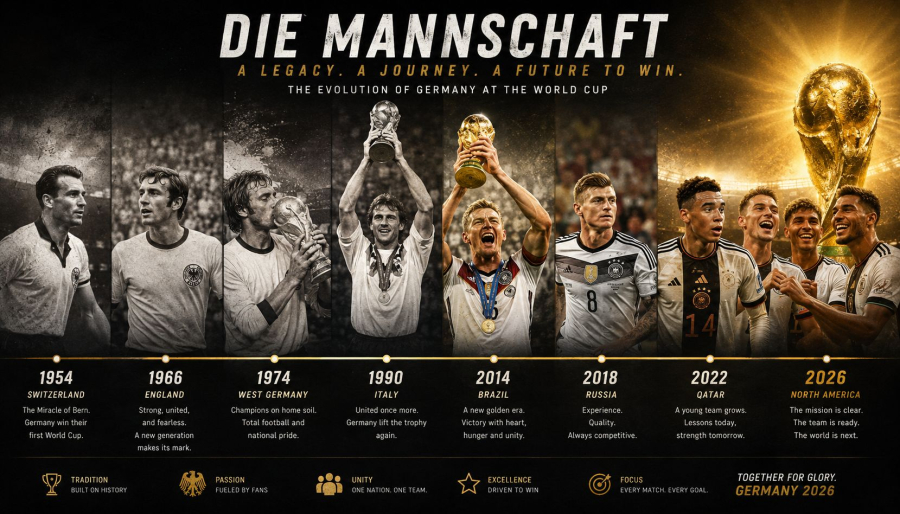
The headline achievements: Germany’s World Cup record in one glance
Germany’s World Cup history is the definition of elite consistency. Across eras, managers, and tactical trends, the team has repeatedly proven it can go deep in the tournament.
- 4 World Cup titles: 1954, 1974, 1990, 2014
- 8 World Cup finals: a record-level total, placing Germany among the most frequent finalists in tournament history
- 13 top-four finishes: a remarkable “always in the conversation” track record
- All-time World Cup icon: Miroslav Klose is the tournament’s all-time top scorer with 16 goals
The bigger takeaway: Germany doesn’t just peak once. It reloads, adapts, and returns.
World Cup trophies and finals: the data that screams “big-game team”
Germany’s trophy cabinet is world-class. But the real flex is the number of finals appearances: repeatedly reaching the last match means you’re not just talented, you’re structurally prepared for knockout football.
| Year | Finish | Notes |
|---|---|---|
| 1954 | Champions | Often remembered as the “Miracle of Bern,” a landmark moment in German football history. |
| 1966 | Runners-up | Another final appearance that signaled Germany’s long-term arrival as a global power. |
| 1974 | Champions | Germany won on home soil, reinforcing its reputation for handling pressure. |
| 1982 | Runners-up | A deep run in a highly competitive era. |
| 1986 | Runners-up | Back-to-back finals appearances demonstrate sustained excellence. |
| 1990 | Champions | Germany lifted the trophy again, showing the program’s ability to renew and win. |
| 2002 | Runners-up | Another final, another proof point: Germany finds ways to win knockout matches. |
| 2014 | Champions | Germany became the first European nation to win a World Cup held in the Americas. |
From 1954 to 2014, Germany’s finals span multiple football generations. That’s not a “golden era.” That’s a culture.
All-time World Cup performance: the kind of totals only giants can post
One of the simplest ways to measure greatness is volume at a high level: matches played, wins collected, and goals scored across decades. Germany sits right at the top tier historically.
| Category (Men’s FIFA World Cup) | Germany all-time total (as of 2022) | Why it matters |
|---|---|---|
| Matches played | 112 | Longevity + frequent deep runs add up to a huge sample of elite performance. |
| Wins | 68 | One of the highest win totals in World Cup history. |
| Draws | 21 | Tournament football rewards control, and Germany has historically managed game states well. |
| Losses | 23 | Low loss count relative to match volume is a signature of elite consistency. |
| Goals scored | 232 | Germany is among the top scorers in World Cup history, showing attacking output across eras. |
These are not “one-tournament” numbers. They reflect a program that repeatedly shows up, repeatedly competes, and repeatedly creates chances on the biggest stage.
The “Germany effect”: why they’re so reliable in knockout football
Fans often describe Germany as a team that becomes more dangerous as a tournament goes on. That reputation didn’t appear out of nowhere. Several practical, repeatable advantages have defined Germany’s best World Cup teams.
1) Tournament experience is built into the identity
World Cups reward teams that manage pressure, pacing, and momentum shifts. Germany’s long history of deep runs means the program has learned, over decades, what it takes to win consecutive high-stakes matches.
2) The mentality: structured, calm, and ruthless when it counts
Germany is famous for turning tight games into results. In knockout matches, small moments decide everything: a set piece, a defensive recovery, one clean counter, one clinical finish. Germany has repeatedly produced teams that do the basics at an elite level when nerves are highest.
3) Depth and role clarity
Great World Cup teams usually have more than “star power.” They have a full squad of players who understand their roles. Germany’s best sides have typically combined top talent with clear responsibilities: disciplined defending, coordinated pressing, and midfield structure that keeps the team connected.
4) Tactical adaptability across eras
From the classic tournament pragmatism of earlier decades to modern possession and pressing, Germany has proven it can evolve. The 2014 champions are a strong example: technically comfortable, tactically flexible, and capable of controlling matches without losing their edge.
Icons who define World Cup excellence (and the records to prove it)
A World Cup legacy is never just about trophies; it’s also about the players who set the standard for what “World Cup greatness” looks like. Germany has produced some of the most influential tournament performers ever.
Miroslav Klose: the ultimate World Cup finisher
Klose holds a place in football history that no defender wants to see on the scouting report: he is the all-time top scorer in men’s World Cup history with 16 goals. That record is a huge part of Germany’s “big tournament” brand: consistent chance creation plus a striker who consistently converts.
Lothar Matthäus: the durability standard
Matthäus is widely associated with elite longevity at the World Cup, holding the record for most World Cup matches played with 25. That kind of availability and leadership is priceless in a tournament where every minute can swing history.
Gerd Müller: efficiency before “efficiency” was a buzzword
Gerd Müller’s goalscoring legacy is often cited among the purest examples of penalty-box excellence. He won the Golden Boot in 1970 with 10 goals, helping define the idea that Germany can pair structure with lethal finishing.
Thomas Müller: space-finding made famous
Thomas Müller won the Golden Boot in 2010 (5 goals) and built a World Cup reputation around movement, timing, and end product. He’s a modern symbol of a classic German advantage: turning intelligent off-ball play into goals and assists.
Fun facts that make Germany’s World Cup story even better
Stats are powerful, but fun facts are what make a team’s identity stick. Germany’s World Cup timeline is full of moments that feel like they belong in a documentary.
- Germany has reached 8 World Cup finals, a staggering number that underlines how often they make it all the way to the last day.
- Germany has 13 top-four finishes (including titles, runners-up, third place, and fourth place). That’s a long-term pattern of being in the final weekend conversation.
- Germany won the 2014 World Cup in Brazil, becoming the first European team to win a World Cup staged in the Americas.
- The 2014 semifinal ended 7–1 in Germany’s favor against the host nation, the largest margin ever in a World Cup semifinal and one of the tournament’s most talked-about matches.
- “Die Mannschaft” is a widely used nickname associated with the national team brand, reflecting a “team-first” identity.
Why Germany is always a smart “favorites” pick
Being the “best” in World Cup terms isn’t only about claiming talent. It’s about demonstrating repeatable qualities that win tournaments:
- Proven ability to reach finals (8 appearances)
- Proven ability to win titles (4 trophies)
- Record-setting individuals (Klose’s 16 goals; Matthäus’s 25 matches)
- Consistent elite placement (13 top-four finishes)
- Big-match performances that stand out in World Cup history
In other words, Germany doesn’t rely on a single superstar or a single trend. They’ve won with different styles, different leaders, and different generations. That breadth is exactly why they’re feared: you can’t “wait them out.”
What “Germany at the World Cup” typically looks like on the pitch
Every tournament is different, and each squad has its own personality. Still, Germany’s best World Cup teams tend to share some recognizable traits that translate into results.
Structured defending that enables fast, clean transitions
Germany’s most successful tournament teams usually defend as a unit, not as a collection of individuals. That structure helps them win the ball and immediately attack with purpose.
Midfield control and smart positioning
World Cups are often won in midfield: controlling tempo, preventing counterattacks, and sustaining pressure. Germany’s historical strength here has been the ability to keep shape, recycle possession, and still break lines when the moment appears.
Set-piece danger
In tournament football, set pieces can be the difference between going home and going to the next round. Germany has long been associated with disciplined execution on dead balls, turning preparation into real goals.
A quick timeline of Germany’s “never out of it” reputation
If you want a simple explanation of why Germany is so often called the ultimate tournament side, look at how regularly they returned to the later rounds across multiple decades.
- 1954–1974: A rise from champions (1954) to champions again (1974), including a 1966 final.
- 1982–1990: A run that included multiple finals and culminated in the 1990 title.
- 2002–2014: Another final (2002), then multiple deep runs, crowned by the 2014 championship.
The outcome is a global expectation: even when Germany isn’t the flashiest team, opponents know that a one-goal lead is never safe and a 50–50 match can swing Germany’s way.
Conclusion: the case for Germany as “the best” is built on proof
If “the best” means the most repeatable excellence on the biggest stage, Germany has one of the strongest cases in football history. The combination of 4 titles, 8 finals, 13 top-four finishes, and record-setting legends like Miroslav Klose creates an unmistakable message: Germany is not just a great World Cup team. Germany is a World Cup standard.
And that’s the real reason Germany enters every World Cup conversation with confidence: their legacy isn’t a slogan. It’s a résumé.
