Few national teams have shaped the FIFA World Cup as consistently and successfully as Germany. Across nearly a century of tournaments, Germany (including the era of West Germany) has become synonymous with elite preparation, tactical adaptability, and a culture of delivering on the biggest stages. The result is a World Cup record defined by deep runs, iconic players, and four championship stars.
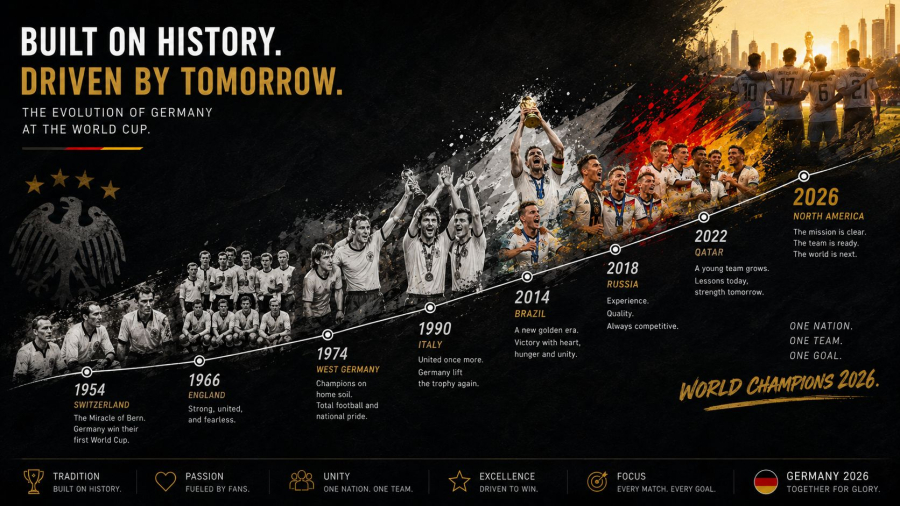
This guide covers Germany’s World Cup journey from the earliest editions to modern triumphs, highlighting the biggest successes, signature matches, and the system-level strengths that helped Germany become one of football’s enduring benchmarks.
Germany at a Glance: Why Their World Cup Record Stands Out
Germany’s World Cup story is not just about winning trophies. It is also about sustained excellence: frequent semifinal appearances, multiple finals, and an ability to rebuild across generations while staying competitive.
- World Cup titles: 4 (1954, 1974, 1990 as West Germany; 2014 as Germany)
- Runner-up finishes: 4 (1966, 1982, 1986 as West Germany; 2002 as Germany)
- Third-place finishes: 4 (1934, 1970 as West Germany; 2006, 2010 as Germany)
- Hosts: 2 (1974 as West Germany; 2006 as Germany)
That blend of championships and repeat appearances in the final rounds has made Germany a reference point for how to build a winning national team program over time.
Understanding the Team Name: Germany vs West Germany
When discussing World Cup history, it helps to understand how Germany’s teams are recorded:
- Germany competed in early World Cups and then again as a unified nation after reunification.
- West Germany represented the Federal Republic of Germany during the Cold War era and achieved major World Cup successes.
- East Germany qualified for the World Cup once (1974), separate from West Germany.
In football history and statistics, West Germany’s World Cup achievements are generally treated as part of the same tradition that continued after reunification, culminating in Germany’s 2014 title.
The Early Years: Germany Enters the World Cup Story
1934: A Fast Rise to Third Place
Germany quickly announced itself as a tournament force by finishing third in 1934. That early podium set a tone that would define the program for decades: competing for the highest places, even as the sport and tournament evolved.
Post-war Return and the Build Toward Greatness
After the interruption of World War II, Germany returned to World Cup competition and built a foundation that would produce one of football’s most celebrated championship stories.
The Breakthrough: 1954 and the “Miracle of Bern”
Germany’s first World Cup title came in 1954 (as West Germany) in a final that became legendary: the victory over the heavily favored Hungary is widely remembered as the “Miracle of Bern.”
Why this triumph still matters today:
- A defining underdog win: It showed that belief, preparation, and game management could topple even the most dominant teams.
- A national milestone: The win carried enormous cultural significance and helped cement football as a central part of Germany’s modern sporting identity.
- A blueprint for resilience: The team’s comeback spirit became part of the “Germany at tournaments” narrative for generations.
Key figure associated with this era includes Fritz Walter, captain and symbol of the 1954 side.
1966: Narrowly Missing the Title
By 1966, West Germany again reached the World Cup final, finishing as runner-up. While the trophy did not arrive that year, the achievement reinforced a major theme in Germany’s World Cup history: they return to the late stages again and again, even as tactics and eras change.
The 1970s Peak: Stars, Style, and a Home World Cup Win
1970: Third Place and a Golden Generation
West Germany finished third in 1970, powered by a squad that included iconic names such as Franz Beckenbauer and Gerd Müller. This era is often celebrated for combining efficiency with high-level talent and leadership.
1974: Champions on Home Soil
In 1974, West Germany hosted the World Cup and won it, capturing a second title. Winning at home is uniquely powerful: the team not only delivers on expectations but also elevates the tournament experience for supporters nationwide.
Why 1974 stands as a cornerstone success:
- Winning under pressure: Host nations face intense expectations, and West Germany met them.
- Legendary leadership: Beckenbauer’s influence helped define the role of the modern leader on the pitch.
- A complete tournament performance: The champions navigated elite opponents and high-stakes games with composure.
The 1980s: Finals, Consistency, and Tournament Mastery
If one word captures Germany in the 1980s, it is consistency. West Germany reached the final in both 1982 and 1986, finishing runner-up each time.
These campaigns are a reminder of a major advantage Germany has often held at the World Cup:
- Repeatable performance: Even as squads change, the system remains capable of going deep.
- Knockout readiness: Germany’s historical comfort in elimination matches helped keep them in contention.
- Leadership culture: Tournament football rewards teams with calm decision-making, and Germany repeatedly excelled in that environment.
1990: A Third Title and a Classic Team
West Germany claimed its third World Cup title in 1990. This victory is often associated with disciplined tournament management and top-level players such as Lothar Matthäus.
Beyond the trophy, 1990 represents a high point in Germany’s long-term pattern of excellence: when the team arrives with a balanced squad, it becomes extraordinarily difficult to stop.
The Unified Era Begins: Germany After Reunification
2002: Back in the Final
Germany reached the World Cup final again in 2002, finishing as runner-up. The run demonstrated the program’s ability to retool and compete at the highest level even when not universally considered the favorite at the start of the tournament.
A major individual storyline from this era includes elite goalkeeping performances, highlighting a traditional German strength: producing top-tier keepers who can decide knockout matches.
2006: The “Summer Fairy Tale” and a Home Boost
Germany hosted the World Cup in 2006 and finished third. While it was not a championship, it became a hugely positive tournament remembered for vibrant atmospheres and renewed national enthusiasm.
From a benefit-driven perspective, 2006 mattered because it:
- Re-energized the fan culture with a welcoming, celebratory tournament atmosphere.
- Helped accelerate development by spotlighting the value of modern training, youth pathways, and tactical evolution.
- Created momentum for the next generation of stars.
2010: A New Generation Arrives
Germany’s third-place finish in 2010 signaled the rise of a dynamic new era. The team combined structure with technical quality and pace, demonstrating a modernized playing identity built to compete with any style.
This tournament also set the stage for several players to become global references in their positions, and it reinforced Germany’s reputation for building squads that peak at the right time.
2014: World Champions Again (and One of the Most Iconic Runs Ever)
Germany’s fourth World Cup title came in 2014, a triumph that stands among the program’s greatest achievements. The campaign is remembered for tactical control, squad depth, and composure in the biggest moments.
The Semifinal That Shook the Football World
The 7–1 semifinal win over Brazil became one of the most talked-about matches in World Cup history, not only because of the scoreline but because it showcased ruthless efficiency and total team coordination at the highest level.
Winning the Final
Germany sealed the 2014 title with a final victory decided in extra time, delivering the ultimate payoff for years of planning and development.
2014 is often celebrated as a “complete project” win:
- Depth across positions: Germany could adapt to different opponents without losing identity.
- Elite leadership: Calm decision-making under pressure was visible from defense to attack.
- Modern football principles: Pressing, possession control, and intelligent movement were executed at championship level.
Players from this era commonly highlighted include Philipp Lahm, Manuel Neuer, Thomas Müller, and Miroslav Klose (the tournament-era striker who became the World Cup’s all-time leading scorer during this period, a record he holds with 16 World Cup goals).
Germany’s World Cup Honors: A Clear Summary Table
| Achievement | Years | Notes |
|---|---|---|
| Champions | 1954, 1974, 1990, 2014 | 1954, 1974, 1990 as West Germany; 2014 as Germany |
| Runners-up | 1966, 1982, 1986, 2002 | Multiple finals across different eras |
| Third place | 1934, 1970, 2006, 2010 | Frequent deep runs that show sustained quality |
| Hosted | 1974, 2006 | 1974 hosted by West Germany; 2006 hosted by Germany |
What Germany Does Exceptionally Well at the World Cup
Germany’s success is not accidental. Across decades, several strengths show up repeatedly, helping explain why Germany has remained a standard-setter in World Cup football.
1) Tournament Mentality and Game Management
World Cups are won with more than talent. Germany has repeatedly shown the ability to handle pressure, protect leads, and make smart decisions as matches tighten.
2) Tactical Flexibility
From classic structured setups to more modern pressing and possession control, Germany has evolved with football. That flexibility helps the team stay competitive even as trends change.
3) Leadership and Accountability
Germany’s best teams typically feature clear on-field leaders: captains, organizers, and experienced players who stabilize the team during key moments.
4) Development Pathways That Feed the National Team
Elite World Cup squads are built over many years. Germany’s ability to produce waves of strong players across positions has been central to returning to the late rounds repeatedly.
Iconic Germany World Cup Figures (By Legacy Impact)
- Franz Beckenbauer: A defining figure of Germany’s 1970s excellence, influential as both player and leader.
- Gerd Müller: One of football’s most celebrated finishers, central to the era’s attacking success.
- Lothar Matthäus: A symbol of the 1990 champions, representing elite midfield leadership.
- Miroslav Klose: Germany’s reliable tournament striker who became the World Cup’s all-time leading scorer with 16 goals.
- Manuel Neuer: A modern goalkeeping reference point, associated with Germany’s 2014 triumph.
- Philipp Lahm: A model of consistency and intelligence, captaining the 2014 champions.
- Thomas Müller: A defining attacker of the 2010s era with a major impact in multiple tournaments.
Germany’s Biggest World Cup Successes, Ranked by Historical Impact
- 2014: A modern masterpiece combining depth, tactics, and iconic moments, capped by the title.
- 1954: The “Miracle of Bern,” a foundational championship that became part of football folklore.
- 1974: Winning at home with a legendary squad and leadership, strengthening Germany’s identity as a football powerhouse.
- 1990: A complete tournament win that confirmed the long-term strength of West Germany’s program.
Cultural and Football Benefits of Germany’s World Cup Legacy
Germany’s World Cup history delivers benefits that go beyond match results. For fans, players, and the wider football world, the German example offers several lasting positives:
- Inspiration across generations: Repeated deep runs create heroes, memories, and motivation for young players.
- A model for long-term excellence: Germany shows how planning, development, and clarity of playing principles can create sustained success.
- Memorable tournaments as a host: Hosting in 1974 and 2006 created defining sporting moments and elevated fan experiences.
- Global influence: Germany’s players and approaches have influenced tactics, coaching ideas, and performance standards worldwide.
Conclusion: Germany’s World Cup Story Is a Masterclass in Sustained Success
From an early podium finish in 1934 to legendary titles in 1954, 1974, 1990, and 2014, Germany’s World Cup history is a powerful example of what happens when talent meets preparation and tournament intelligence. The biggest successes are not isolated peaks; they are the product of a football culture that repeatedly finds ways to compete for the game’s greatest prize.
If you want, I can also provide a tournament-by-tournament Germany World Cup timeline (every edition they played), a list of Germany’s top World Cup goal scorers, or a breakdown of Germany’s most iconic matches with context on why each mattered.
