A Germany vs Curaçao matchup at the 2026 FIFA World Cup would be one of the tournament’s most fascinating contrasts: a global heavyweight with a deep footballing infrastructure against an ambitious, fast-improving nation from the CONCACAF region. While no one can guarantee specific fixtures in advance (the World Cup draw and qualification paths determine who plays whom), comparing the two programs makes it clear why Germany would enter as a strong favorite.
This guide breaks down the key information you’d want to know about a potential Germany vs Curaçao game at World Cup 2026: tournament context, team profiles, style matchups, squad depth, and the practical reasons Germany is better positioned to win.
World Cup 2026 context: what changes, and why it matters
The 2026 FIFA World Cup is scheduled to be hosted across the United States, Canada, and Mexico. It is also the first men’s World Cup with an expanded field of 48 teams, which changes how nations qualify and how group-stage games can play out.
What the 48-team format means for Germany and Curaçao
- More qualified teams means more opportunities for nations outside traditional power centers to reach the tournament, which increases the chances that a team like Curaçao could qualify or face elite opposition.
- Less margin for slow starts: big teams still need to be sharp early. Even favorites can be punished if they underestimate an opponent or waste chances.
- Depth becomes even more valuable over a longer tournament cycle. Nations with deeper player pools can rotate more effectively while maintaining quality.
In that context, Germany’s structural advantages (depth, experience, and elite-level competition exposure) become even more meaningful.
Germany vs Curaçao: quick team profile comparison
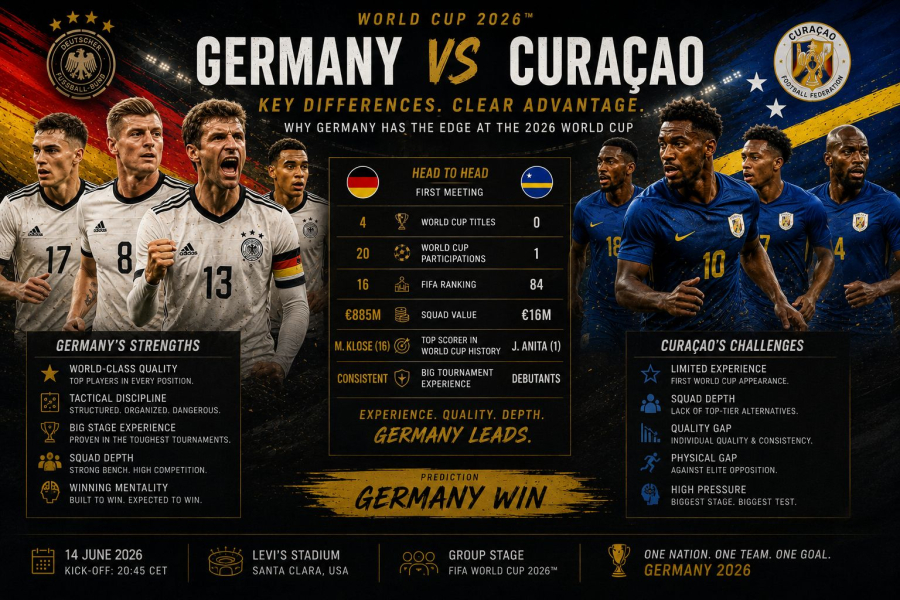
| Category | Germany | Curaçao |
|---|---|---|
| Confederation | UEFA | CONCACAF |
| World Cup pedigree | Four-time men’s World Cup champions (1954, 1974, 1990, 2014) | No men’s World Cup finals appearances to date |
| Typical opponent level | Regularly faces top European nations in qualifiers and UEFA competitions | Faces a mix of CONCACAF opponents; fewer matches vs top-tier European teams |
| Player pool | Large, elite club pipeline; many players in top European leagues | Smaller pool; many players develop in the Netherlands or regional leagues |
| Tournament experience | High collective experience in major tournaments | Growing experience; fewer players with late-stage major tournament exposure |
This doesn’t diminish Curaçao’s ambition or quality on its day. It simply frames the reality: Germany’s competitive environment and historical results place them among the favorites in most matchups.
How Germany can win: the biggest on-field advantages
To explain why Germany would be favored against Curaçao, you don’t need hype. You need clear football reasons: the types of chances each team can create, how often they can sustain pressure, and what happens when the game becomes chaotic.
1) Squad depth and role specialization
Germany’s most reliable advantage is depth. In a single match, depth shows up as:
- Multiple solutions to the same problem (for example, more than one strong option for progressing the ball, breaking down a low block, or protecting a lead).
- Higher quality substitutions that keep the tempo high rather than simply “holding on.”
- Specialists across phases: set-piece takers, press-resistant midfielders, wide one-v-one players, and center backs comfortable in a high line.
Curaçao can absolutely have standout individuals, including players with European club backgrounds. But the gap typically appears when you compare the full matchday squad and the ability to change the game from the bench.
2) Comfort in high-pressure, high-tempo games
Germany’s players are generally accustomed to:
- Facing aggressive pressing schemes
- Playing in stadiums with intense atmospheres
- Managing momentum swings over 90 minutes
Against a team like Curaçao, Germany can benefit from controlling the match rhythm: speeding up play to force mistakes, then slowing it down to limit counterattacks.
3) Tactical flexibility: multiple ways to dominate
Germany’s advantage is not only “better players.” It’s also the ability to win with different game plans, such as:
- Possession control to pin Curaçao back and create sustained pressure.
- High pressing to win the ball closer to goal and generate high-value chances.
- Quick transitions if Curaçao commits numbers forward.
In practical terms, this means Curaçao must solve multiple problems at once: defend wide areas, protect the space between the lines, and still keep enough attacking threat to discourage Germany from overcommitting.
How Curaçao can compete (and what Germany must respect)
A benefit-driven preview still needs to be realistic: World Cup matches punish complacency. Curaçao’s best path to a competitive game typically involves disciplined defending, fast transitions, and set-piece danger.
1) Compact defending and counterattacks
If Curaçao stays compact and forces Germany to attack in front of them, the match can become about patience and finishing. This is exactly why Germany’s chance creation and shot quality management matter: the favorite wants to avoid turning the match into a low-event game decided by one mistake.
2) Players with European football backgrounds
Curaçao has historically benefited from players connected to Dutch football pathways, which can raise the technical level and tactical understanding of the squad. Even without naming a specific 2026 roster (because squads evolve), the broader point stands: Curaçao is capable of organized, well-coached phases.
3) Set pieces as an equalizer
In international football, set pieces can swing matches. Curaçao’s upside increases if they:
- Win fouls in wide areas
- Force corners through direct runs
- Make the game physically intense in the box
Germany’s counter to that is preparation: strong set-piece defending structure, clear assignments, and avoiding cheap fouls in dangerous zones.
Key matchup areas: where Germany’s edge is most decisive
Midfield control and progression
Germany’s ability to progress the ball through midfield is often the foundation of their attacking volume. When Germany can reliably move the ball into advanced zones, they force opponents into long defensive stretches, which increases fatigue and concentration errors.
For Curaçao, the priority becomes disrupting the central build-up and forcing play wide. If Curaçao cannot consistently disrupt Germany’s progression, the match can tilt heavily toward Germany in both territory and chances.
Wide overloads and final-third passing
Against compact teams, a common route to goals is creating overloads wide and then finding runners in the box. Germany’s advantage here is the combination of:
- Technical crossing and cut-back quality
- Timing of late runs from midfield
- Rotations that pull defenders out of shape
The more Germany can force Curaçao’s back line to shift side-to-side, the more likely gaps appear for decisive passes.
Game management: leading vs chasing
One of the clearest separators between top international teams and developing programs is what happens after the first goal.
- If Germany scores first, they can choose between controlled possession, strategic pressing, or selective counterattacks.
- If Curaçao scores first, Germany’s depth and experience chasing games becomes valuable: they can increase attacking quality without losing structure.
This is a major reason Germany is favored: they have more “paths to victory” across different scorelines.
Why Germany is likely to win: a clear, factual case
Predicting football is never a certainty, but you can assess probabilities based on repeatable factors. Germany would be favored against Curaçao because of:
- Elite tournament pedigree: Germany is historically one of the most successful men’s World Cup nations.
- Depth across positions: quality options in defense, midfield, and attack, including impact substitutes.
- Higher baseline competition: regular matches against strong UEFA opposition create a faster tactical and physical reference level.
- Multiple tactical routes: Germany can win via control, pressure, transitions, or structured attacking patterns.
- Consistency over 90 minutes: favorites often win by sustaining performance while opponents fade physically or mentally.
Put simply: Curaçao can absolutely produce moments. Germany is more likely to produce enough high-quality moments across the whole match to win.
Projected match story: what a Germany win often looks like
If Germany plays to their strengths, a typical winning match narrative could look like this:
- Early control: Germany establishes possession, pins Curaçao in, and limits transition chances.
- Chance accumulation: shots and final-third entries build through wide overloads and central combinations.
- Breakthrough: a goal arrives via a cut-back, a set-piece routine, or a well-timed run behind the line.
- Second-phase dominance: Germany uses depth to maintain intensity and protect against counters.
Even if Curaçao defends bravely, the sustained pressure and volume of quality attacks is often what separates top teams from underdogs.
What would have to happen for Curaçao to upset Germany?
While the focus here is on why Germany is favored, it’s useful to understand the upset recipe, because it highlights what Germany must do well.
- Clinical finishing from few chances: Curaçao converting one or two key moments.
- Elite defensive concentration: minimizing errors for 90 minutes.
- Set-piece swing: scoring or creating decisive danger from dead balls.
- Germany wastefulness: missed chances that keep the match close and increase pressure.
Germany’s advantage is that they can reduce upset risk by being ruthless in the final third and disciplined in rest defense (their structure behind the ball when attacking).
Bottom line
A Germany vs Curaçao game at World Cup 2026 would spotlight the beauty of the tournament: different football cultures, different resources, and a chance for emerging nations to test themselves against established powers. Curaçao’s growth and potential make them an opponent worth respecting.
At the same time, Germany’s combination of World Cup-winning history, deep player pool, elite competitive environment, and tactical flexibility gives them a clear edge. If Germany plays with focus and efficiency, they are strongly positioned to win this matchup.
