If you’ve seen references to a Germany vs Curaçao match on 14/06 tied to the World Cup, it’s worth clearing up a key point first: there has not been an official FIFA World Cup finals match between Germany and Curaçao, and Curaçao has not appeared at a men’s World Cup finals tournament under the Curaçao name.
That doesn’t mean the conversation is pointless. People often search for this kind of matchup in a few situations:
- It’s a hypothetical preview (for example, a simulated fixture, a fan discussion, or a video game scenario).
- It’s a misread schedule where Germany played a different opponent on June 14 in a past World Cup.
- It’s a non-World Cup game (friendly, tournament warm-up, or another competition) mistakenly labeled as “World Cup.”
With the facts stated upfront, we can still do what many readers want: explain why Germany would be expected to win if Germany and Curaçao met in a World Cup-level context (or any high-intensity international match).
First, the factual checkpoint: Germany vs Curaçao is not a World Cup finals fixture
In the men’s FIFA World Cup finals, the matchups are fully documented and widely archived. Germany (including West Germany, and unified Germany post-1990) has an extensive World Cup history, while Curaçao has not qualified for a World Cup finals tournament. Because of that, a Germany vs Curaçao World Cup match on 14/06 is not an official, historical World Cup event.
Also, June 14 appears in World Cup schedules across multiple editions, so the date can be easy to mix up with other fixtures. If you have a specific tournament year attached to “14/06,” that detail usually changes what the date actually refers to.
Still, the underlying question remains useful: What would make Germany the stronger side in a head-to-head matchup?
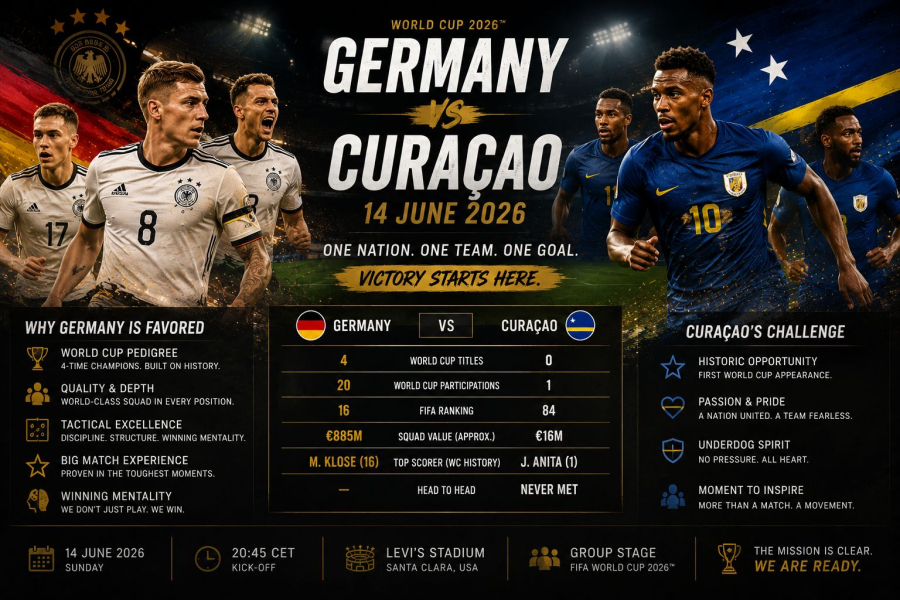
Why Germany would be favored: the big-picture advantage
When analysts preview international matches, they look at repeatable advantages that tend to decide games: player depth, tactical structure, tournament experience, and the ability to manage momentum swings. On those fundamentals, Germany is typically positioned as one of world football’s heavyweight programs.
Here are the main reasons Germany would be favored against a smaller international side like Curaçao.
1) Tournament pedigree and high-pressure experience
Germany’s national team has been built for major-tournament football for decades. That matters because World Cup-style matches are rarely decided on talent alone; they are often decided by:
- Decision-making speed under pressure
- Game management when leading (or chasing)
- Discipline across 90 minutes
- Comfort in high-stakes moments
Germany’s player pool is far more likely to include athletes who regularly compete in high-pressure club and international environments. That experience becomes a competitive edge when the match turns tense or chaotic.
2) Depth and competition for places
One of Germany’s most consistent advantages is depth. In practical terms, depth means:
- High-quality options in multiple positions
- Different profiles available (pace, aerial strength, ball progression, pressing ability)
- A bench that can change the match without a dramatic drop in quality
In a matchup where Germany is expected to control large stretches, depth is especially powerful because it sustains intensity. A team can defend well for an hour and still concede once fatigue increases and concentration drops.
3) Tactical structure that travels well
International football has fewer training days than club football, so systems that are clear and repeatable tend to win. Germany is traditionally associated with:
- Structured pressing (knowing when to press and when to hold)
- Organized possession with purposeful circulation
- Controlled transitions to reduce counterattack risk
Against an opponent likely to defend deeper, Germany’s structure helps create chances without relying on low-percentage shots.
How Germany’s strengths translate into goals
To explain why Germany would likely win, it helps to translate “advantages” into the moments that decide matches: shot quality, territory, set pieces, and defensive stability.
Germany would expect to control territory and possession
In a typical “favorite vs underdog” match, possession isn’t just about keeping the ball. It’s about pinning the opponent back and forcing repeated defensive actions. That builds pressure in three ways:
- More entries into the final third means more chances for cutbacks, rebounds, and defensive errors.
- More set pieces (corners and free kicks) accumulate as defenders clear danger.
- More fatigue for the defending team, which can lead to late goals.
Germany’s attacking variety is a matchup problem
What usually separates elite international teams is not just having one route to goal, but having multiple credible routes. Germany can typically create chances through:
- Wide overloads and crosses
- Half-space combinations that open passing lanes behind midfield lines
- Third-man runs that disrupt man-marking
- Set pieces that punish even small lapses in marking
For a smaller nation, defending one pattern is already difficult. Defending four or five patterns for an entire match is where favorites often pull away.
Set pieces: a quiet edge that wins games
Set pieces are a major factor in international football because they compress the game into rehearsed moments. A team with:
- consistent delivery,
- strong aerial ability,
- well-drilled blocking and movement,
can generate high-value chances even when open play is crowded. Germany has historically treated set pieces as a serious weapon, and that alone can decide a match where an underdog defends well for long stretches.
Why Curaçao would face an uphill battle in a World Cup-level scenario
Staying factual and respectful, the main challenge for Curaçao in a hypothetical Germany matchup is not desire or effort. It’s the reality of international football ecosystems: the biggest nations tend to have broader player pools, deeper professional infrastructures, and more repeated exposure to elite competition.
In practical match terms, an underdog often has to be near-perfect in several areas at once:
- Defend the box without conceding set pieces
- Avoid turnovers in build-up under pressure
- Take rare chances with clinical finishing
- Maintain concentration against waves of attacks
That’s a lot to demand over 90 minutes, especially if Germany scores first and can dictate tempo.
A simple tactical story: how Germany would aim to win
If Germany were approaching this as a must-win World Cup group match, the game plan would typically revolve around fast control: establish territorial dominance early, create high-quality chances, then manage the match with minimal risk.
Phase 1: Start fast to avoid a “stuck” match
Favorites often want an early goal because it changes everything:
- It forces the underdog to open up (even slightly).
- It creates more space for runners and combination play.
- It reduces the chance of a late, chaotic equalizer.
Germany’s best version is usually proactive early: crisp circulation, quick switches of play, and aggressive counter-pressing to keep the opponent pinned.
Phase 2: Sustain pressure and win second balls
Against a deeper defensive block, second balls become decisive. Germany’s midfield structure would likely aim to:
- keep attacks alive after clearances,
- recycle possession quickly,
- prevent counters before they start.
This is how control turns into chances: the opponent cannot breathe long enough to reset.
Phase 3: Turn control into a second goal
At 1–0, underdogs still believe. At 2–0, the match often becomes about management. Germany would typically push for a second goal through:
- fresh legs off the bench,
- set-piece pressure,
- increased risk from the opponent creating counterattacking space.
Key “winning reasons” summarized
If you want a clear, persuasive explanation for why Germany would be expected to win, it comes down to repeatable advantages that show up in almost every elite-vs-underdog matchup.
| Factor | Why it points toward Germany |
|---|---|
| Experience in major tournaments | More players accustomed to high-pressure, high-intensity matches and game management |
| Squad depth | Strong options across positions and impactful substitutes to sustain intensity |
| Control of territory | More time in the attacking third leads to more chances, corners, and mistakes forced |
| Chance creation variety | Multiple routes to goal (wide play, combinations, cutbacks, set pieces) |
| Defensive structure | Better ability to prevent counters and limit high-quality shots conceded |
| Set-piece threat | Rehearsed routines and aerial presence can decide tight matches |
What a convincing Germany win would look like
In a hypothetical World Cup match, a “Germany doing Germany things” performance is usually defined by control plus efficiency. Here’s what that tends to look like on the pitch:
- High possession with purpose, not sterile passing
- Quick ball recoveries after losing possession
- Shots from strong locations (cutbacks, central box entries, second-phase set pieces)
- Limited counterattacks conceded
- Composure after scoring, keeping the opponent chasing
When those boxes are ticked, Germany’s probability of winning rises sharply—because the match becomes less about randomness and more about repeatable quality.
If you meant a specific real match on 14/06, here’s how to get the exact answer
If your intent was to reference an actual World Cup match on June 14 (14/06) involving Germany, the missing detail is the tournament year. With the year, it becomes possible to identify the exact fixture and provide a factual recap: opponent, scoreline, key moments, and what it meant for the group.
But if your goal is a forward-looking preview or a simulated “Germany vs Curaçao” analysis, the conclusion remains straightforward: Germany would be favored because of its deeper player pool, stronger tournament experience, and more reliable ways to create and convert chances.
Bottom line
There is no official men’s World Cup finals match listed as Germany vs Curaçao on 14/06. However, as a matchup analysis, the reason many would back Germany is clear and factual: Germany typically brings elite-level depth, structure, and big-game experience that, over 90 minutes, tends to turn control into goals—and goals into wins.
If you share the year you’re referencing for “14/06,” I can tailor this into a precise, factual match explainer for the correct Germany fixture on that date.
